

The healthiest thing I do all summer isn't a supplement
Cold Swims, cooking for friends, a wider range of plants. The Science of why the free stuff is the good stuff.

THE INNER CLOCKS · FREE EDITION · JULY 2026
It is barely six in the morning and I am walking into a cold, grey-green sea, waiting for a wave I can already see building. I do this most mornings through the summer, before the day starts asking things of me. People assume, because of what I do for a living, that my health comes out of a bottle. It mostly comes out of mornings like this one. And they are free.

I want to make a slightly awkward confession for someone who advises on supplements. The healthiest things I do all summer cost nothing. A cold swim at first light. Long, slow dinners where I cook for friends and we sit outside until the light finally goes. A run through a city I don’t know, on the rare week I take off. None of it comes in a capsule, and all of it does more for my gut, my sleep, and quite possibly my lifespan than the supplements I could sell you.
That’s not a fashionable thing to say in July, when everyone is selling a summer glow-up. So let me actually show you the evidence, because this isn’t a vibe. It’s some of the most robust nutrition and circadian science we have, and almost none of it sits behind a paywall or a checkout.
◆ ONE THING YOU CAN DO TODAY
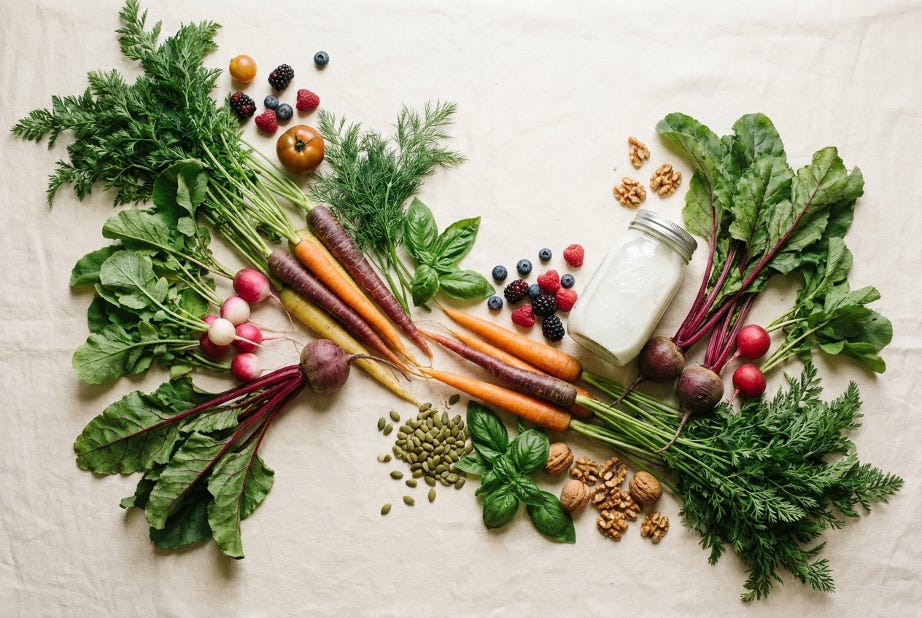
If you take one thing from this, make it this. Eat a wider range of plants this week than feels necessary. Not more food. More kinds. Different vegetables, a scatter of seeds and nuts, herbs by the handful, a couple of new fruits. Aim, across the week, for thirty different plant types. It sounds like a lot until you realise a single mixed salad and a spice-heavy dinner can move the count by ten.
(Members get the exact one-pot dinner I cook for friends, and my real supplement routine, later this month. But the sentence above is the free version, and it’s the one that matters most.)
Your gut wants variety, not a “super”-anything
Here is the finding that reorganised how I eat, and how I feed my clients. The single strongest dietary predictor of a diverse, resilient gut community isn’t a probiotic, or a powder, or a superfood. It’s simply how many different plants you eat.
In the American Gut Project, one of the largest citizen-science microbiome datasets ever assembled, people who ate more than thirty different plant types a week had measurably more diverse gut communities than people who ate fewer than ten. Notice what that quietly demotes: it was the plant count that tracked with a healthier gut, not whether someone called themselves vegan, keto or carnivore. Labels lost. Diversity won.
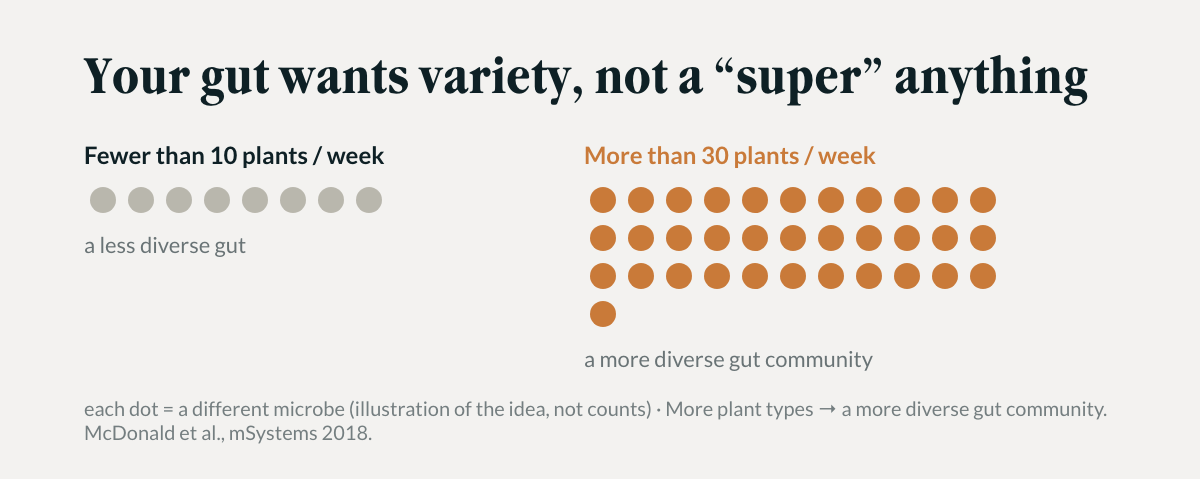
The mechanism is almost obvious once you say it out loud. Different plants carry different fibres, and different fibres feed different microbes. A gut fed on the same three foods is a monoculture waiting to happen. A gut fed on herbs, seeds, nuts, legumes, whole grains and a wide rotation of vegetables is a community with something for everyone.
And this is exactly where cooking for friends quietly wins. A meal you make to share is almost never one beige thing on a plate. It’s a couple of vegetables, some herbs, seeds scattered on top, a salad nobody planned. Without trying, a good shared summer meal pushes your plant count up. A summer of feeding people is, biologically, a summer of feeding your microbiome well. I’ve written before about how a wider range of plants shifts the whole ecosystem in your gut.
The fastest lever is already on your table
If diversity is the foundation, fermented food is the fastest way to shift the whole community, and here the human evidence is genuinely strong.
In a randomised trial at Stanford, a diet high in fermented foods (yoghurt, kefir, kimchi, sauerkraut, kombucha) steadily increased gut microbiome diversity and lowered a broad set of inflammatory markers in the blood over ten weeks. Strikingly, a high-fibre diet didn’t raise diversity as reliably in the same window. That surprised a lot of people, myself included, because we treat fibre as the answer to everything. Fibre matters enormously, but it feeds the microbes you already have. Fermented foods appear to widen the community itself.
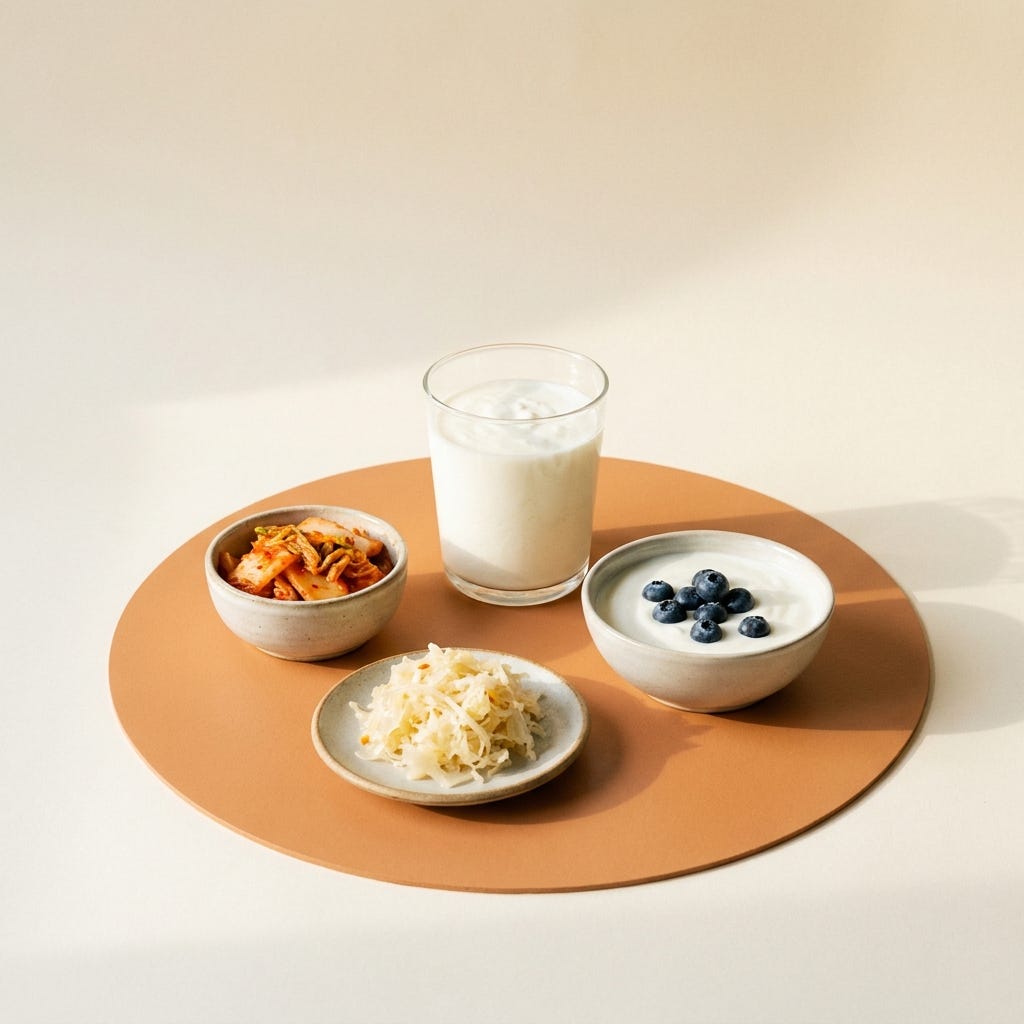
This is why the kefir in the morning and the sauerkraut next to almost everything off the grill aren’t garnish. They’re one of the few genuinely fast levers you have, and they hide in plain sight at every relaxed meal. I go deeper into this in fermented foods for microbiome diversity and lower inflammation.
The sunrise is doing more than you think
Here’s the part I care about most, because it’s my field. That cold morning light hitting my eyes isn’t decoration. It’s a dose.
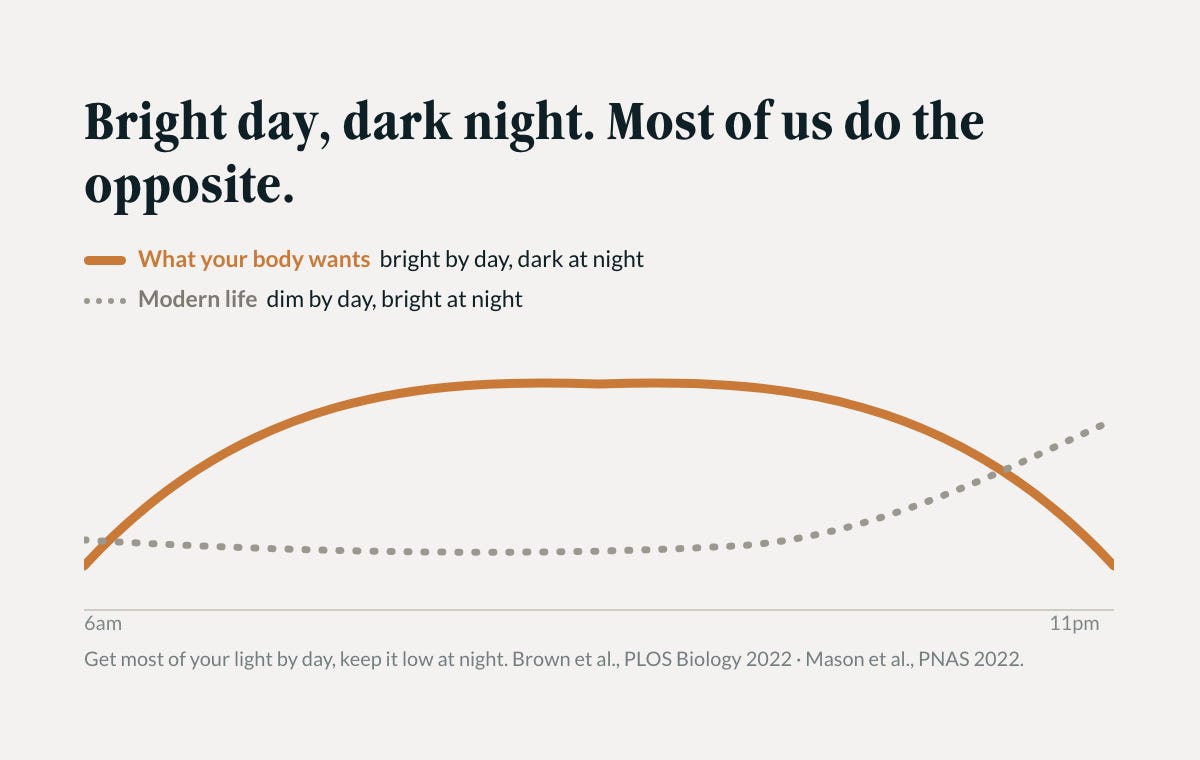
Your body clock doesn’t run on willpower. It runs on light. A group of the field’s leading circadian scientists published consensus recommendations that come down to one shape: get plenty of light by day, and keep it low at night. Most modern lives get this exactly backwards. Dim by day, in offices and cars. Bright by night, under downlights and screens. A morning in the sea is a big dose of the right light at the right time, and it’s free.
And when you flip that pattern, your body pays for it. In a controlled sleep-laboratory study, healthy adults slept one night in near-darkness and one night under moderate room light. On the lit night, their heart rate ran higher through the night, and the next morning they were measurably more insulin resistant. One ordinary night with the light left on. So the morning swim and the dark bedroom are the same lever, pulled in opposite directions. I’ve written the fuller version of this in the power of light in our circadian rhythm, and made a short video on why your evening melatonin is set hours earlier than you think.
The part I can’t measure but won’t ignore
This is the softest claim of the piece, so I’ll make it carefully. There’s a large body of research linking strong social connection to a longer, healthier life, on a scale that sits alongside the usual suspects like smoking and exercise. I’m not going to pretend the mechanism is fully mapped, or that a dinner party is a prescription. But when I look honestly at the healthiest parts of my summer, the common thread isn’t a nutrient. It’s other people, outside, around food. That’s not nothing, and I suspect it’s closer to the centre of health than most of what we argue about online.
Where I stop
I owe you the honest edges, because that’s the whole point of this newsletter. I’m not telling you supplements are useless. I use them, I recommend them, and one of them is the subject of a members’ edition this month. What I’m telling you is the order of operations. The free, boring, social, outdoor things come first, and they do most of the work. A supplement is what you reach for when the foundations are in place and a specific gap remains, not a shortcut around a life you haven’t built yet.
So what do I actually do?
Get outside in the morning light before the day starts. Eat a wider range of plants than feels necessary. Keep one fermented thing on the table most days. Feed people you love as often as you can. And leave the evening genuinely dark. None of it costs anything, and it’s doing more than the shelf of bottles most of us are quietly guilty about.
This month, for members, I go two steps deeper: the exact one-pot dinner I cook for friends (with the gut science behind every ingredient), and the honest, simple version of my own daily routine, the Gut-Sleep Protocol I actually take. If the free stuff is the foundation, those two are the finishing touches.
Tell me one thing before you go. What’s the healthiest thing you do in summer that comes without a label on it? Reply, or leave it in the comments. I read every one.
Warmly,
Adriano dos Santos, MSc, rNutr, IFMCP, MBOG, RSM
The Circadian Nutritionist™
References (every study above is a live hyperlink)
McDonald et al., mSystems 2018 · plant diversity & the gut microbiome (PMID 29795809)
Wastyk et al., Cell 2021 · fermented foods raise diversity, lower inflammation (PMID 34256014)
Brown et al., PLOS Biology 2022 · light/dark consensus recommendations (PMID 35298459)
Mason et al., PNAS 2022 · one night of room light raised insulin resistance (PMID 35286195)